State Seal State Seal State Seal
Home Button Home Button Home Button
 

Democratic News

Featured Stories

News Feed

{"removedFilters":"","searchUpdateUrl":"\/news\/democrat\/update-search","start":1233,"pageSize":11,"sort":"PublishDateDesc"}

Monroe County Court Judge Jason A. Yoss today traveled to Columbus to shadow state Rep. Jack Cera (D-Bellaire) as part of the Judicial-Legislative Exchange hosted by the Ohio Judicial Conference.

“I am delighted to meet with Rep. Cera to discuss concerns we have in Monroe County and to hear his plans for helping the district. It was also good to reminisce about old times when I served as a Page for the House of Representatives at the Ohio Statehouse,” said Judge Yoss.

The Ohio Judicial Conference helps create uniformity in the application of the law, rules and practice through the state. Ultimately, the OJC helps determine the judicial impact that bills and resolutions have on the state.


Cera proposes solution to state sales tax hike on working people
May 4, 2016

State Rep. Jack Cera (D-Bellaire) today expressed disappointment that the state legislature rejected an amendment aimed at helping working and middle-class families make ends meet by eliminating the sales tax on everyday essential items, such as feminine hygiene products, disposable baby diapers and non-prescription medications and drugs.

The Bellaire lawmaker offered a floor amendment to House Bill 466, legislation to exempt online advertisements from the state sales and use tax. 

“Just as businesses are seeking to roll back the sales tax shift that has been enacted over the past several years, Ohio’s working families are looking to the General Assembly for help,” said Cera. “Tax cuts that disproportionately benefit the wealthiest one-percent have been paid for by shifting taxes onto middle-class and working families. This amendment would have helped restore fairness to Ohio’s tax code.” 


Local reservists want hangar at Air Reserve base to assist deploying soldiers
April 26, 2016

State Rep. John Boccieri (D-Poland) today highlighted some of the community projects that won funding in the 2016 capital budget over the Youngstown Air Reserve Station (YARS)’s request to create a Regional Joint Readiness Center (RJRC) to provide a central point for deploying reservists. The request centered on the cargo apron and hangar that reservists from the 910th Airlift Wing would immediately utilize.

According the Vindicator, the Federal Aviation Administration financed an $11.5 million 13-acre paved cargo apron area on the west side of the airport in 1999. A private developer built a building for airport cargo shipping next to it, but both facilities have remained practically unused since. On a recent visit to the area, U.S. military officials expressed interest in the idea of using the cargo apron and building as a deployment hub for troops and other military assets from all branches of the military from Northeast Ohio as well as nearby portions of neighboring states.

“I’m really surprised that the initial introduction of the capital bill placed ‘pork’ ahead of Ohio’s patriots,” Rep. Boccieri said. “The irony is almost pathetic – legislators want to construct a fifty-foot statue of the Wright brother’s first airplane ahead of prioritizing a project that will have an immediate impact on deploying soldiers who fly out of the Air Reserve Station.”

Instead of appropriating even one dollar to Western Reserve Port Authority, the legislature is on track to give $80,000 to the Bowling Green Curling Club and $500,000 toward a soccer stadium in Columbus. In addition, the state is granting the full funding amount requested by the Madcap Production for a new puppet theater, and $1 million to the Cleveland Rock and Roll Hall of Fame Museum for a single exhibi


Akron lawmaker will work to combat infant mortality rate, other minority health disparities
April 26, 2016

State Rep. Emilia Sykes (D-Akron) today announced her recent appointment to the Ohio Commission on Minority Health (OCMH). As a board member, Sykes will work to support the commission’s efforts to address health disparities among minority populations, including the infant mortality rate for African Americans. According to the Ohio Department of Health, African American babies die at roughly twice the rate of white babies in Ohio.


Voice solidarity with Columbus Working People's Day of Action on Feb. 24
February 23, 2018

Ohio House Democratic Leader Fred Strahorn (D-Dayton) and Democratic House members from across the state today issued statements in support of the Working People’s Day of Action planned for Saturday, February 24 at the Ohio Statehouse. The Ohio march comes on the heels of the introduction of six Republican-sponsored constitutional amendments to implement so-called “right to work” legislation and other workplace restrictions in the Buckeye State. 


Every Ohioan depends on clean, safe water. Water is easy to take for granted. Turn on the faucet, and it is available.

Ohio is a water-rich state, bounded by Lake Erie on the north and the Ohio River on the south, with many streams and rivers within its borders.

In recent years, there have been concerns about the role Ohio’s agriculture community plays in protecting our environment, specifically as it relates to water quality. The good news is – through the passage of comprehensive legislation and detailed environmental regulations, Ohio has in place a robust infrastructure that can and does efficiently and effectively preserve our land, air and water.


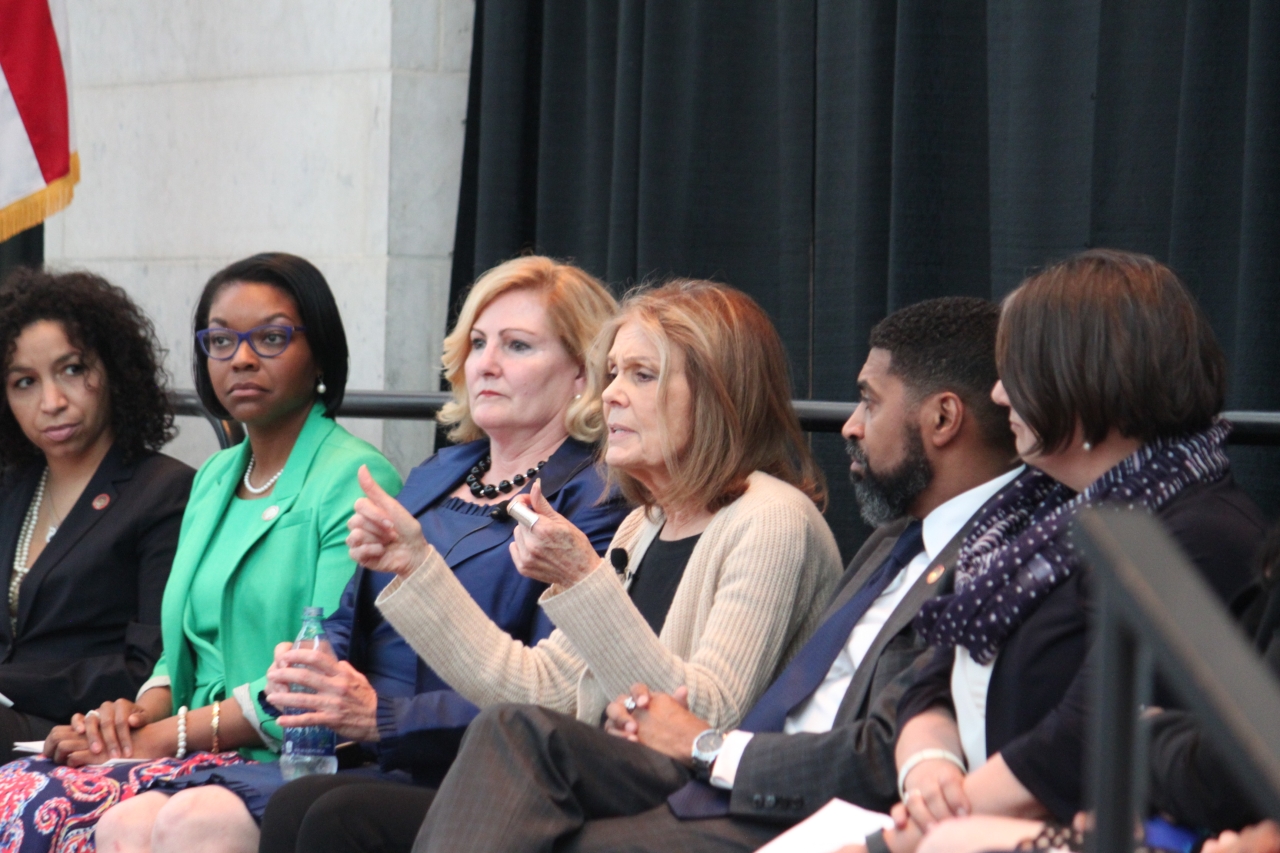
Celebrated feminist, journalist discusses Ohio issues during "Real Talk" forum
April 21, 2016

The Ohio House Democratic Women’s Caucus (OHDWC) today is hosting nationally renowned American feminist, activist and journalist Gloria Steinem for a series of events at the Ohio Statehouse. Born in Toledo, Ohio, Gloria Steinem was a key figure during the women’s rights movement of the late 1960’s and has received numerous bestselling book awards for her novels on women’s issues on personal, national and global levels. 

“Gloria Steinem is an inspiring hero and role-model for women in Ohio and across the nation,” said Rep. Teresa Fedor (D-Toledo), chair of the OHDWC. “From the gender wage gap, to restrictions on women’s access to healthcare, to outdated and incomplete laws against rape, many of the challenges women in Ohio face today are the same issues Gloria has been fighting against and raising awareness of for decades. The challenges we face in Ohio are certainly real, but they are not insurmountable if we come together, speak with one voice and make a stand.” 


State estimates Ohioans will lose coverage under plan signed by Kasich
April 21, 2016

State Rep. Emilia Sykes (D-Akron), the lead Democratic member on the Health and Human Services House budget panel, today joined House Democratic lawmakers to file a formal protest with the Ohio Department of Medicaid (ODM), opposing proposed restrictions and additional barriers to healthcare for working poor Ohioans. 


State lawmakers say U.S. Senate must uphold constitutional duty to advise and consent on Supreme Court nomination
April 20, 2016

State Rep. Dan Ramos (D-Lorain) and State Sen. Michael Skindell (D-Lakewood) today introduced companion legislation in their respective chambers to urge the U.S. Senate to consider the nomination of Appeals Court Judge Merrick Garland to the U.S. Supreme Court. The president nominated Garland on March 16, but the U.S. Senate has so far refused to hold hearings to consider his nomination.


Ohio Legislative Black Caucus (OLBC) President and State Rep. Alicia Reece (D-Cincinnati) today applauded the selection of Harriet Tubman as the new face of the U.S. $20 bill.


House Democratic Leader Fred Strahorn (D-Dayton) and Rep. David Leland (D-Columbus), the top Democrat on the House Federalism and Interstate Relations Committee, today asked Speaker Cliff Rosenberger (R-Clarksville) to reconsider legislation that loosens multiple gun laws and penalties, House Bill 228.

The House Federalism and Interstate Relations Committee is debating the sweeping changes under House Bill 228 instead of the House Criminal Justice Committee, a panel the lawmakers say is better equipped to deal with such radical changes to criminal laws around firearms.

“This complex bill is replete with repercussions that not only impact the law enforcement community but the public safety of the entire state,” the lawmakers wrote. “The eyes of the nation are on Ohio and we have the opportunity to show thoughtful and responsible deliberation on a bill that stands to dramatically impact criminal charging as well as penalties with regard to firearms. The Ohio Legislature has a responsibility to our communities to get this right.” *

The bill would change the burden of proof in a self-defense claim when a firearm is involved, reduce criminal penalties for illegal or improper use of handguns, and prohibit local communities from enacting their own gun safety laws.

*A copy of the letter is attached.


Legislation would give caller direct access to 9-1-1 responders
April 15, 2016

In honor of National Public Safety Telecommunications Week, State Rep. Greta Johnson (D-Akron) today announced the introduction of “Kari’s Law”, legislation that aims to make it easier for Ohioans to dial 9-1-1 in cases of emergency. The bill would require multi-line telephone systems—such as the ones used by hotels and offices—to allow direct access to 9-1-1, eliminating the need for a dial out number.


State report reveals minority-owned businesses receive disproportionately low percentage of state highway contracts
April 15, 2016

President of the Ohio Legislative Black Caucus (OLBC) State Rep. Alicia Reece (D-Cincinnati) and State Rep. Stephanie Howse (D-Cleveland) called on the state Friday to take action to reduce barriers between state highway contract opportunities and minority-owned businesses in Ohio. A “disparity study” released Friday by the Ohio Department of Transportation (ODOT) revealed that minority and women-owned businesses receive a disproportionately small percentage of the state highway contract opportunities available. 

“Today’s news confirms what we already knew: that minority-owned businesses still face too many barriers – historic and systemic – to economic opportunities in this state,” said Reece. “It took over 30 years for the state to finally meet its Minority Business Enterprise benchmarks, and we cannot wait another 30 years to close the gap in connecting minority-owned businesses with highway construction contracts and jobs opportunities. The state can do more to create a fair and equitable environment for minority-owned businesses.”

Reece said the OLBC wants to see the state do more through increased diversity within the ODOT organization, greater access to capital and bonding for minority companies, a statewide urban apprenticeship and on-the-job training program, Minority Business Enterprise inclusion for ODOT projects, and an internship initiative with Ohio’s historically black colleges – Wilberforce University and Central State University.

Reece also said the OLBC is calling for a legislative halt to proposed local hiring bans, Senate Bill 152 and a House-passed companion version, which would prohibit communities from setting local workforce participation standards on infrastructure construction projects – a tool that has been used in urban cores with high-minority population density like Cleveland, Akron, Toledo and Cincinnati.


Say mergers could reduce competition, raise consumer costs
April 13, 2016

The two highest ranking Democrats on the House and Senate Insurance Committees today called for public hearings on the potential mergers of four of the five national health insurance companies in the United States. State Rep. Heather Bishoff (D-Blacklick) and State Sen. Edna Brown (D-Toledo) were joined by a mother with a child with asthma in requesting that the Ohio Department of Insurance (ODI) hold public hearings on any proposed mergers.


Ohio to join 48 states in protecting victims of dating violence under HB 1
February 20, 2018

The Ohio Senate is expected to pass state Rep. Emilia Sykes’ (D-Akron) House Bill (HB) 1 today, bipartisan legislation to modernize Ohio’s domestic violence laws. Co-authored with state Rep. Nathan Manning (R-N. Ridgeville), HB 1 will allow victims of dating violence to obtain civil protective orders against their attacker, a protection currently allowed in every state except Ohio and Georgia.

“I am pleased that the Senate will take action today to protect people who are victims of dating violence,” Sykes said. “Unfortunately, Ohio is one of the last states to recognize dating relationships when requesting a protection order. Thankfully it is never too late to save a life.”*

The National Dating Violence Hotline defines intimate partner violence, which includes dating violence, as a repetitive pattern of behaviors – including physical or sexual violence, threats, intimidation, emotional abuse and economic deprivation – used to maintain power and control over an intimate partner.

Current Ohio law only recognizes domestic violence as violence occurring between spouses, those cohabiting, persons who have a child in common, or family members. The senate amendments add dating relationships to the existing domestic violence statute, giving victims rights including information from the attorney general’s office and access to battered women’s shelters.

The House will likely approve Senate changes to the bill in the coming weeks. The legislation then will head to the Gov. Kasich’s desk for his anticipated signature.
 
 
Lawmakers say new restrictions will hurt economy, increase healthcare costs
February 16, 2018

State Reps. Nickie J. Antonio (D-Lakewood) and Emilia Strong Sykes (D-Akron) today expressed disappointment regarding proposed Medicaid restrictions released this afternoon by the Kasich Administration.

The Administration is seeking the restrictions in a waiver request to the federal government that stems from Republican attempts to undercut the state’s Medicaid expansion in the previous state budget. Though the Administration claims no more than 36,036 Ohioans are in jeopardy of losing healthcare coverage under the new restrictions, the actual number of people impacted could be significantly higher if the economy slows down, or more people have trouble finding work. 


State Rep. Jack Cera (D-Bellaire) today responded to this morning’s well pad emergency near Powhatan Point in Belmont County, Ohio.

Cera noted that state officials from ODNR assured him that the agency is working with the OEPA and local emergency officials to minimize the impact on local residents and the environment surrounding the spill and fire.

“ODNR has reached out and are working with local officials for the safety of our residents and the protection of our natural resources. It is my understanding that XTO officials are setting up a hotline to help address questions and concerns regarding temporary housing, etc. I will continue to monitor the situation and work with all parties to ensure that the creek is restored to the way it was before this incident took place.” 


House bill will designate May Maternal Mortality Awareness Month
February 12, 2018

State Rep. Emilia Strong Sykes (D-Akron) today announced legislation that would designate the month of May in Ohio “Maternal Mortality Awareness Month” to recognize the Ohio mothers who die each year from pregnancy related complications.

The number of Ohio mothers who die from pregnancy related complications has increased threefold from a decade ago. The average death rate in 2016, according to the Ohio Department of Health, is 85 women per 100,000 live births.

“Ohio has the opportunity to be a leader in maternal mortality awareness,” said Sykes. “By designating a month for awareness, we will bring light to the various causes of maternal mortality, develop new ideas and protocols to limit and eliminate pregnancy related death, and show the women of Ohio that the state supports their health and well-being during and after pregnancy.”


State Rep. Teresa Fedor (D-Toledo) and Toledo native and feminist icon Gloria Steinem today issued the following statements on the politically motivated closure of Toledo’s Capitol Care Network, a healthcare facility that provides abortion care:

"I was born and grew up mostly in Toledo. Later, when I needed an abortion -- as has one in three American women at some time in our lives -- I was in London, where it was safe and legal. This taught me why medical procedures should not be decided by politicians.

“We must not allow a political regulatory scheme to close Toledo’s remaining abortion clinic. Its absence would not diminish the number of abortions but would increase the injury and death of women in my home city and state. Democracy begins with each person's control of his or her own body. Without reproductive freedom, there is no democracy for America women.

“I strongly urge ProMedica and St. Luke's Hospital to safeguard women's health by signing the transfer agreement needed to keep safe, legal abortion services available in Greater Toledo.  Ohio hospitals must not allow themselves to be used by politicians to hurt women’s health.”—Gloria Steinem


“The Ohio Supreme Court ruled against the reproductive rights and health of Ohio women by upholding a regulatory scheme designed to close Toledo’s only remaining abortion clinic. I know that if this clinic closes, women in northwest Ohio will suffer. I urge ProMedica and St. Luke's Hospital to safeguard women's health by signing the transfer agreement needed to keep abortion services safe and legal in the Toledo area. We can’t let politicians use Ohio hospitals to eliminate a safe, constitutional medical procedure.” —Rep. Teresa Fedor (D-Toledo)


Following months of negotiation, the Ohio House today passed Senate Joint Resolution 5, bipartisan legislation that puts a constitutional amendment before voters in May to restrict congressional gerrymandering in the state. 

“After months of negotiation, thousands of Ohioans speaking out, and several false starts, we’re closer to stopping congressional gerrymandering today than we have ever been before. Though imperfect, this latest plan represents one of the most fundamental tenets of our American democracy – compromise,” said House Democratic Leader Fred Strahorn (D-Dayton). “We support this plan today, with the hope and expectation that it will help impart that same spirit and guiding principle of cooperation on Washington in the near future.”

Democratic House expressed concerns over several parts of the proposed plan that they see as loopholes that, in extreme cases, could still allow partisan congressional district rigging. Ultimately, most Democrats still supported the final language in the resolution.


Each February, Black History Month raises awareness about the significant portion of the American story that African Americans have authored. From science and business to literature, the arts and public service, Black History Month highlights the struggles and triumphs of our nation.


Say bill puts families first, allows Ohio businesses to attract, retain top talent
January 31, 2018

State Reps. Janine Boyd (D-Cleveland Heights) and Kristin Boggs (D-Columbus) today announced legislation to establish the Ohio Family and Medical Leave Insurance Program, which would provide economic stability to working families in times of a medical emergency, when caring for a sick loved one, or welcoming a newborn into the family. While federal law provides some workers the ability to take leave, it does not provide those workers with any guarantees that they will have compensation while on leave.


House Bill 440 will establish a single-payer health care plan for all Ohioans
January 31, 2018

State Reps. Teresa Fedor (D-Toledo) and Bernadine Kennedy Kent (D-Columbus) today provided sponsor testimony for House Bill (HB) 440, known as the Ohio Health Security Act, to establish a single-payer health care plan in Ohio. Medical, dental, mental health and vision services will be covered under the bill and payments to health care providers for all eligible services will be made from a single fund called the Ohio Health Care Fund.

“It is time to focus on patients, not profits,” Fedor said. “Health is a human right. The Ohio Health Security Act provides security, freedom, choice, stability, and certainty. No more guessing games, no more living one slip and fall away from bankruptcy.”