



Representatives Odioso, Dovilla Highlight Legislation to Expand Inspector General's Search Warrant Authority
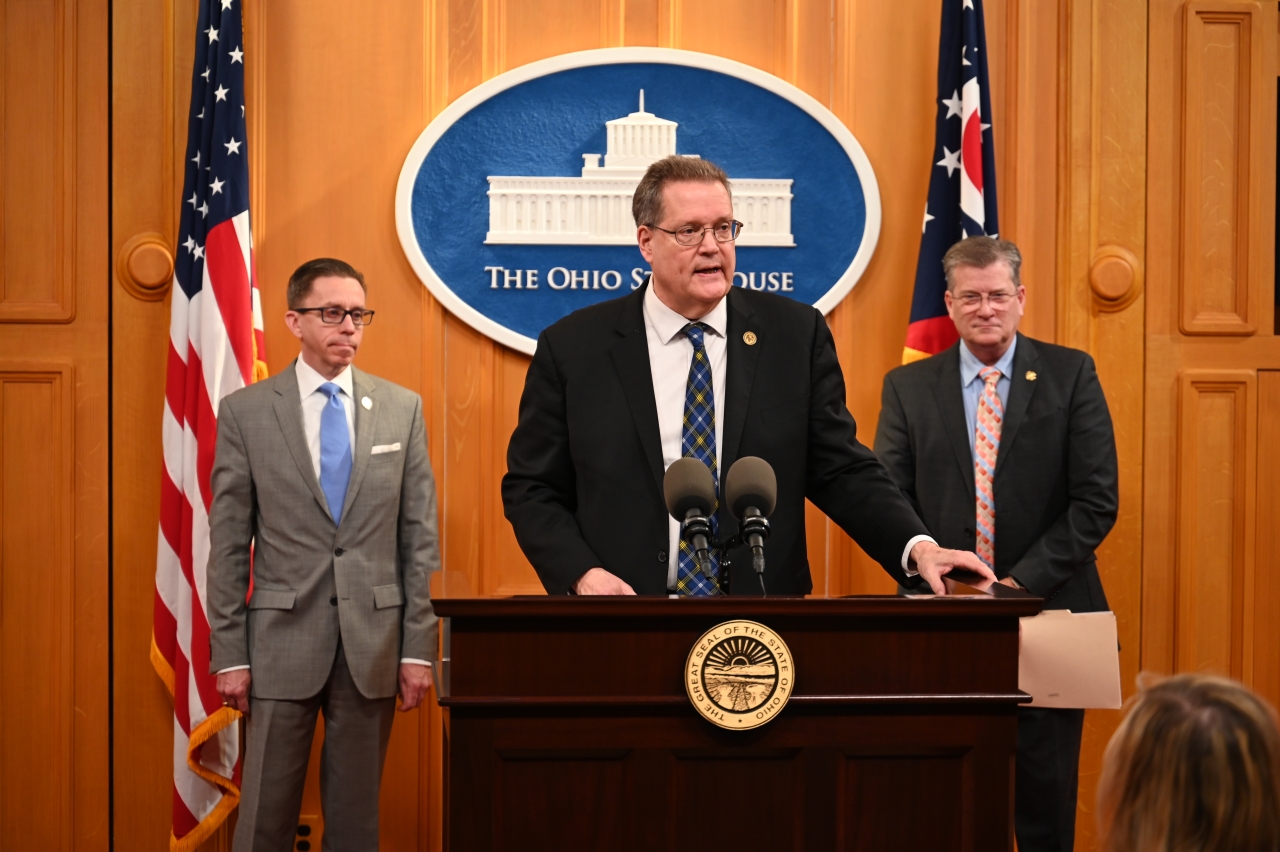
State Representatives Mike Odioso (R-Green Twp.) and Mike Dovilla (R-Berea) yesterday held a press conference to discuss House Bill 683, companion legislation to Senator Thomas Patton’s (R-Strongsville) Senate Bill 350. The bill is designed to grant the Ohio Inspector General’s Office law enforcement authority when acting within the scope of its statutory duties.
The legislation responds to ongoing instances of fraudulent activity by individuals and vendors operating under the state watchdog’s jurisdiction. House Bill 683 authorizes qualified investigators in the Inspector General’s office to petition a court for electronic warrants when appropriate, strengthening the office’s ability to conduct thorough and effective investigations.
Since becoming Inspector General in 2011, Randall Meyer’s office has released 811 reports of investigation and identified over a quarter of a billion dollars in lost funds to the State of Ohio.
"This legislation better equips qualified investigators to combat fraud, waste, and abuse in Ohio," said Ohio Inspector General Randall Meyer.
Numerous investigations conducted by the office during the last five years have increasingly necessitated the use of search warrants to obtain electronic evidence. For example, between 2021 and 2025, the Inspector General’s office was involved in 20 investigations related to fraud in the Pandemic Unemployment Assistance (PUA) benefits program. Those investigations resulted in more than 50 indictments and uncovered over $30 million in losses to the State of Ohio and individuals legally entitled to receive those benefits.
“House Bill 683 provides the Inspector General’s office with the practical tools to investigate potential fraud within state government and state vendors, while still preserving judicial oversight with the requirement for probable cause,” said Representative Odioso.
The vast majority of critical evidence in these types of investigations is obtained through electronic search warrants, including emails, text messages, social media records, and other data stored in the Cloud. To date, the office is dependent on other law enforcement entities to seek this evidence from the courts on their behalf. Without this evidence, investigations are less effective and efficient.
Law enforcement authority is not uncommon for Inspector General Offices. All federal inspector generals have law enforcement authority, and multiple State inspector general’s offices, including Pennsylvania, Virginia, and Georgia. Nationally, the trend is for inspector generals’ offices, at all levels of government, to have this authority to investigate possible wrongdoing, safeguard the public interest, and strengthen trust in government.
“House Bill 683 is part of a broader effort to strengthen government accountability and protect taxpayer dollars,” said Representative Dovilla. “Ohioans have made clear that they expect vigilance when it comes to waste, fraud, and abuse, particularly in large public programs. This legislation helps ensure the Inspector General has the tools necessary to root out misconduct and safeguard the integrity of state government.”
The jurisdiction of the office is broad and extends to the Governor and his staff, state agencies, state vendors, departments, boards, commissions, state universities, and medical colleges, which collectively employ more than 100,000 employees. The Inspector General’s Office will continue its long-time, established working relationships with other State, Federal, and local authorities.
Representatives Odioso and Dovilla, Senator Patton, and Ohio Inspector General Meyer held a press conference yesterday to discuss House Bill 683.
To watch the press conference, click here.
The bill has been assigned to the House Public Safety Committee and awaits its first hearing.